“How many hours of English are there each week?” This is usually the first question that comes to mind when it comes to an English programme. The number of hours matters: learning a language requires regular and sufficiently long exposure to it. But hours alone are not enough. How much children use the language during those hours, how much they speak and the content through which they learn it are at least as decisive as the hours themselves.
At Özel Lider Güneşli Koleji, English begins in kindergarten at age 3 and continues without a break until Grade 8. Our programme is approved by the MEB (Turkish Ministry of National Education) and has been designed in line with the Common European Framework of Reference for Languages (CEFR). In this article, we describe the weekly lesson hours, the methods we use and how language development is measured, level by level.
Start early, keep it regular
Young children approach the sounds and rhythm of a new language with a natural openness; at this age, play, songs and stories are the most natural ways of carrying language. Another advantage of starting early is time: a child whose language journey begins at age 3 is exposed to the language for much longer over their school years.
Even so, age alone is not decisive in language learning. Research shows that, particularly in a school setting, the amount, regularity and quality of exposure to the language are at least as important as the age at which learning starts. This is why we build our programme on both sufficient lesson hours and activities in which the language is genuinely used.
Weekly English hours by level
| Level | Weekly English |
|---|---|
| Kindergarten (ages 3–5) | Half-day English |
| Grade 1 | 15 hours |
| Grade 2 | 12 hours |
| Grade 3 | 12 hours |
| Grade 4 | 12 hours |
| Grade 5 | 18 hours |
| Grade 6 | 12 hours |
| Grade 7 | 10 hours |
| Grade 8 | 8 hours |
In kindergarten we support English within the natural flow of the day through a half-day English approach. Age 5 is also the year in which preparation for primary school begins, with phonological awareness activities, pre-writing line work and correct pencil-grip practice. In Grade 5, the first year of middle school, weekly English rises to 18 hours; in Özel Lider Güneşli Koleji’s approach to language education, Grade 5 is a preparatory year with an intensive English programme. German is offered as a second foreign language in Grades 3, 4, 5, 6 and 7.
Learning a language by living it
What matters as much as the hours is how those hours are spent. Three approaches work together in our lessons.
The communicative approach
Our lessons follow the communicative approach, which puts interaction first. In lessons built around games, role-play and problem-solving tasks, the aim is not for students to memorise the language as a school subject but to use it. Our programme aims for students to become individuals who can think critically and creatively and carry out research in the language they are learning.
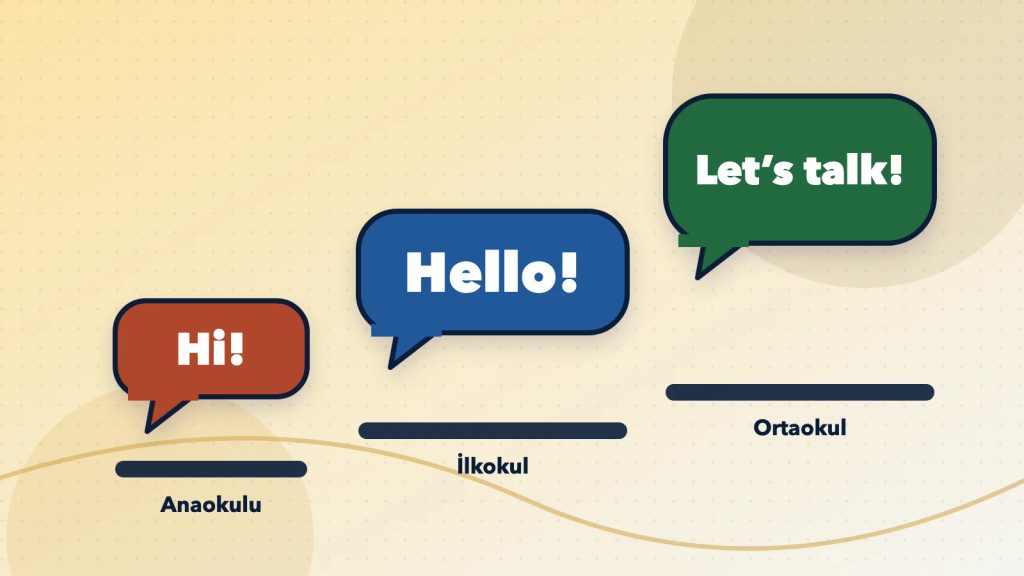
The approach takes shape according to the level:
- In kindergarten, English is learnt not as a lesson but as a natural part of the day, through play and activities.
- In primary school, lessons progress through speaking, games, drama and project activities; the aim is for children to get used to using the language.
- In middle school, speaking, presentations, drama and project-based activities focus on using the language in real life.
CLIL: maths, science and art in English
CLIL stands for Content and Language Integrated Learning. In this approach, language is learnt not only in the language lesson but together with the content of another subject. As children try to understand a concept, they also use the language in a meaningful context; language becomes both the subject and the medium of learning.
At our school, some topics and content from mathematics, science, social sciences, sport and art lessons are integrated into English teaching. In this system, in which all subjects collaborate across disciplines, the aim is to achieve holistic learning by matching project and curriculum content across subjects. CLIL supports our English lessons at every level, from kindergarten to middle school.
The Daily Language Project
In the Daily Language Project, which runs from the age-3 kindergarten class onwards, our students learn the everyday language they may encounter abroad by experiencing it in settings created in the classroom. Through this process, carried out within everyday conversations and activities alongside our Turkish and international English teachers, language acquisition begins in early childhood.
Target levels and international assessment
A measurable path with the CEFR
The Common European Framework of Reference for Languages (CEFR), developed by the Council of Europe, is an international standard that describes language proficiency through levels ranging from A1 to C2; below A1 there is also a Pre-A1 level describing the very first steps. Özel Lider Güneşli Koleji’s target levels for each school level are as follows:
- Pre-A1 or A1 by the end of kindergarten: Children can express their basic needs, deal with simple problems and form meaningful sentences.
- A1+ by the end of primary school: In addition, students understand dates, times and numbers; they can get to know people and ask about places and directions.
- B1 by the end of middle school: Students can start, sustain and close most situations that require communication; they can take part in discussions and put forward their ideas for a project. In the CEFR, B1 is the first of the “independent user” levels.
Exams: ELTA, TOEFL and Cambridge
To monitor our students’ language development against international standards, we run preparation and assessment for the ELTA, TOEFL and Cambridge exams. Cambridge publications are also among our teaching resources.
Exam results:
- provide reliable information about the student’s skills,
- reveal their strengths and areas for development in English,
- show the learning outcomes that need attention in the next stages.
This information is used to support differentiated instruction and to track progress over the year.
Second foreign language: German
Alongside English, German is offered as a second foreign language in Grades 3, 4, 5, 6 and 7.
How can you help at home?
You do not need to speak fluent English to support your child’s English development:
- Choose short but regular exposure: a few minutes of songs, picture books or cartoons every day rather than one long session a week.
- Ask your child to teach you a word or a song they have learnt at school.
- Show curiosity rather than correcting mistakes; children who feel brave enough to try speak more.
- Talk to their teachers about the strengths and areas for development in their progress reports.
You are welcome on our campus
If you would like to see our English lessons and our programme for each level first-hand, we welcome you to our school. Campus visits take place on weekdays, 08:00–18:00, and on Saturdays, 09:00–13:00. You can fill in the enquiry form on our website or call 0553 929 29 95 or 444 2 655 for information from our admissions office.